Source European Tempered Glass Rattan Table and Chair Set for Hotel Bar Outdoor
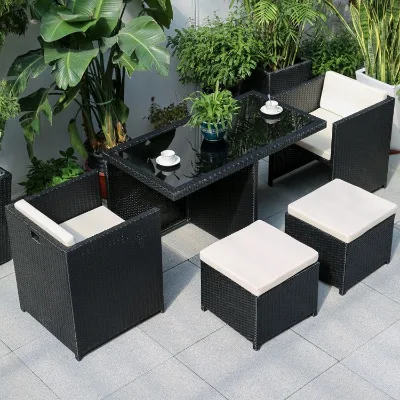
Compare 30 listings of the european tempered glass rattan table and chair set available for hotel, bar, and outdoor dining. Buyers can review specifications including steel frames, rattan seats, and various fabric options like polyester and textilene to find suitable suppliers.
Key considerations
Products List




Comprehensive Sourcing Guide
Strategic Sourcing Guide for European Tempered Glass Rattan Table and Chair Sets
The global market for outdoor and hospitality furniture has seen a significant shift toward hybrid designs that combine the aesthetic appeal of European styling with the durability of modern synthetic materials. For procurement professionals targeting "European tempered glass rattan table and chair sets," the sourcing landscape requires a nuanced understanding of material composition, structural specifications, and compliance standards. This guide synthesizes observed product attributes and industry knowledge to provide a disciplined framework for evaluating potential suppliers and defining precise technical requirements. The focus remains on sets that integrate rattan or wicker elements with tempered glass tops, often featuring steel or metal frames, designed for diverse environments ranging from hotel lobbies to outdoor dining spaces.
Technical Specifications and Material Composition
When evaluating a European-style rattan and glass set, the primary technical differentiator lies in the specific combination of materials used for the frame, seating, and tabletop. The observed market data indicates a prevalence of steel and metal frames, often finished with powder coating to ensure resistance against corrosion and weathering. For instance, specific models utilize a frame construction where the table frame dimensions are noted as 20*10mm and 19mm, while chair frames are consistently 19mm. These dimensions are critical for structural integrity, particularly in sets intended for high-traffic commercial use.
The seating material is a defining characteristic of the "rattan" designation in this context. While traditional natural rattan exists, the supplied facts highlight the use of synthetic alternatives such as "Rattan," "Wicker," and "Shirt Fiber" or "Polyester" fabrics. Some configurations explicitly list "Seat Material: Rattan" or "Band," suggesting a woven aesthetic that mimics natural fibers. The fabric weight varies, with observations of 160g and 180g Polyester, as well as 2X1 Textilene. These variations directly impact the tactile feel and longevity of the seating. For buyers, verifying the exact gram weight and fiber type is essential, as heavier fabrics generally offer better durability against UV degradation and abrasion.
The tabletop component is the other critical specification. The core keyword explicitly mentions "tempered glass," and the data confirms the presence of a "5mm Transparent Tempered Glass" top. This thickness is a standard for safety and stability in dining sets. The glass must be tempered to meet safety standards, preventing shattering into sharp shards upon impact. Additionally, the frame finish is noted as "Powder Coated," a process that provides a durable, uniform color finish that resists chipping and fading. Buyers should verify that the powder coating process is applied to the steel or metal frame to ensure a seamless integration with the rattan weave and glass top.
Design Standards and Configuration Variations
European-style furniture is characterized by specific design languages, often described as "Simple" or "European" in product listings. The configuration of these sets varies significantly, influencing both the price and the logistical requirements for shipping. The observed data reveals multiple standard configurations, including "1 table; 1 double chair; 2 single chair," "1 table; 2 single chair," and "7pcs/set." These variations dictate the spatial requirements for the end-user and the complexity of the packaging.
A detailed comparison of observed configurations highlights the diversity in the market:
| Configuration Standard | Components Included | Typical Application |
|---|---|---|
| 1 Table; 1 Double Chair; 2 Single Chair | 1 Table, 1 Loveseat, 2 Chairs | Hotel Lobbies, Large Dining Areas |
| 1 Table; 2 Single Chair | 1 Table, 2 Chairs | Outdoor Cafes, Balconies |
| 7pcs/Set | 1 Table, 6 Chairs (implied) | Large Banquet Halls, Restaurants |
| 4pcs/Set | 1 Table, 3 Chairs (implied) | Compact Dining Spaces |
The physical dimensions of these sets are equally important for logistics planning. Specific model data indicates a rattan chair item size of 540540680mm, while the table item size is 11201120720mm. For other configurations, packing sizes are listed as 152070920mm for the table and 870520570mm for the chair. These dimensions are vital for calculating container load efficiency, such as the observed capacity of 130 sets in a 40HQ container for specific models. Buyers must cross-reference the item dimensions with the packing dimensions to estimate the actual volume and weight, ensuring that the chosen supplier can optimize the shipping container to minimize freight costs.
Compliance, Certification, and Safety Verification
In the B2B procurement of furniture intended for commercial use, compliance with safety and quality standards is non-negotiable. The supplied facts mention a "Test Report: SGS," indicating that some products in this category undergo third-party testing by recognized inspection agencies. SGS is a global leader in inspection, verification, testing, and certification, and a report from this body provides a baseline of confidence regarding product safety and material quality.
However, buyers must not assume that every listed product automatically possesses this certification. The presence of an SGS report in the data is an observation of specific items, not a universal attribute of all European tempered glass rattan sets. Procurement teams should explicitly request current test reports for the specific model being ordered. These reports should verify the structural integrity of the tempered glass, the stability of the powder-coated frame, and the flammability or chemical safety of the rattan and fabric materials.
Furthermore, the "prod_standard" field in the data lists specific assembly requirements, such as "1 table; 1 double chair; 2 single chair." This suggests that the product standard includes not just the physical attributes but also the assembly instructions and component compatibility. Buyers should verify that the supplier adheres to international furniture safety standards, particularly regarding the stability of glass tops and the load-bearing capacity of the rattan weave. In the European market, compliance with REACH regulations regarding chemical substances and EN standards for furniture safety is often expected. While the supplied text does not explicitly list EN standards, a prudent buyer should verify that the supplier's quality management system aligns with these regional requirements.
Cost Drivers and Procurement Economics
The cost of a European tempered glass rattan set is influenced by several variables, including material quality, customization options, and packaging requirements. The observed price range in the market spans from $1 to $815, a wide spectrum that reflects differences in complexity, material grade, and order volume. The Minimum Order Quantity (MOQ) also varies, with observed ranges from 1 to 620 units. This flexibility allows buyers to source small batches for testing or large volumes for immediate deployment.
Customization is a significant cost driver. The data confirms that "Customization: Available" and "Customized: Customized" are attributes of these products. Buyers can often request specific fabric colors, frame finishes, and even custom packing solutions like "Strong Carton Packing/Mail Box/as Requested." While customization adds value, it may increase the unit cost and extend the lead time. The "Fabric and Frame Color: Any Color Is Available" attribute suggests a high degree of flexibility, but buyers should be aware that custom color requests may require minimum order thresholds to be economically viable.
Packaging is another critical factor affecting the total landed cost. The data mentions "Carton Package," "Stack+Carton Package," and specific packing sizes. Efficient packaging reduces the risk of damage during transit and optimizes container space, directly impacting freight expenses. For example, a set with a packing size of 135X76X55cm will fit differently in a container compared to one with 152070920mm dimensions. Buyers should negotiate packaging standards that balance protection with space efficiency to control overall logistics costs.
Supplier Evaluation and Quality Control Protocols
Selecting a reliable supplier for European-style rattan and glass sets requires a rigorous evaluation process. The origin of these products is frequently listed as "Zhejiang Province," a major manufacturing hub in China known for its furniture industry. While this location offers access to a robust supply chain, it necessitates thorough due diligence. Buyers should verify the supplier's production capacity, quality control processes, and ability to meet customization requests.
Quality control should begin at the factory level. Suppliers should demonstrate a systematic approach to inspecting raw materials, such as the steel frame thickness and the quality of the rattan weave. The "Cushion Thickness: 5cm" specification indicates that comfort is a consideration, and suppliers must ensure that cushioning materials meet durability standards. Additionally, the "Frame Finished: Powder Coated" process requires strict control over the coating thickness and curing temperature to prevent peeling or rusting.
Buyers should also assess the supplier's ability to handle the "Folded: Unfolded" state of the products. Some sets may be designed for easy assembly or disassembly, which is crucial for shipping and storage. The "prod_packing" attribute suggests that packaging can be tailored, but the supplier must ensure that the "Strong Carton Packing" is sufficient to protect the glass and rattan during transit. Requesting pre-shipment inspections and third-party quality audits can mitigate the risk of receiving substandard goods.
Long-Term Procurement and Application Strategy
The application of European tempered glass rattan sets is diverse, ranging from "Hotel, Dining Room, Outdoor" to "Bar" environments. The "Usage" attributes in the data highlight the versatility of these products. For outdoor applications, the resistance of the materials to weather elements is paramount. The steel frame with powder coating and the synthetic rattan or polyester fabric are chosen for their durability in varying climates. However, buyers should verify the specific UV resistance ratings of the fabrics and the corrosion resistance of the frame coatings.
For long-term procurement, consistency in supply is key. The "prod_model" numbers, such as "XS-RTS053," "XS-RTS023," and "FR-ITS012," indicate a structured product line. Maintaining a relationship with a supplier who can consistently produce these models ensures that replacement parts or additional units match the original design. The "40hq: 130set" data point suggests that suppliers have experience with large-scale shipping, which is beneficial for buyers planning expansion.
Furthermore, the "Style: Simple" and "Style: European" attributes indicate a design trend that is likely to remain relevant. Buyers should consider the aesthetic longevity of the design when planning for long-term contracts. The ability to customize colors and configurations allows businesses to adapt the furniture to changing interior design trends without needing to replace the entire set. By focusing on high-quality materials and verified standards, procurement professionals can ensure that their investment in European tempered glass rattan sets delivers value and durability over time.
In conclusion, sourcing European tempered glass rattan table and chair sets requires a detailed understanding of the technical specifications, compliance requirements, and logistical considerations. By leveraging the observed data on materials, dimensions, and configurations, buyers can make informed decisions that align with their specific operational needs. The focus on quality control, supplier evaluation, and long-term planning will ensure a successful procurement strategy that delivers high-performance furniture for diverse commercial environments.
FAQs
What materials are used for the frame and seating?
The frame is constructed from steel or metal with a powder-coated finish. Seating materials include rattan, wicker, or fabrics like 160g polyester, 180g polyester, and 2X1 Textilene.
Can I customize the color of the fabric and frame?
Yes, customization is available for both fabric and frame colors. Buyers can request any color, though specific minimum order quantities may apply for custom requests.
What is the thickness of the tempered glass tabletop?
The tabletop features a 5mm transparent tempered glass top. This thickness ensures safety and stability for dining and bar applications in various environments.
Which configurations are available for these furniture sets?
Available configurations include 1 table with 2 single chairs, 1 table with 1 double chair and 2 single chairs, or 7-piece sets. Specific models vary in component counts.
What is the origin location of these products?
The products originate from Zhejiang Province, China. This region is a known manufacturing hub for furniture with established supply chains for export.
Do these products have third-party safety test reports?
Some products in this category have SGS test reports available. Buyers should verify specific model certifications before purchase to ensure compliance with safety standards.
What is the minimum order quantity for these sets?
The minimum order quantity ranges from 1 to 620 units depending on the specific model and customization requirements. Flexible MOQs allow for small batch testing.